Monday, November 09, 2009
Handy "See-Thru" Propane Tank
Saturday, August 01, 2009
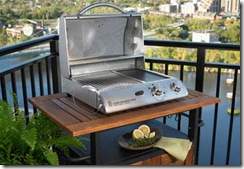
A Better Tailgating Grill
Tuesday, July 07, 2009
TEC Infra-red Grills - Named Best Grill on the Planet
Monday, December 01, 2008
Energy Efficient Grills
Over the years, an unfortunate grill energy story has evolved - gas grill value became synonymous with BTU levels and the number of controls on the grill. Multiple burner grills with higher BTU consumption were slotted with higher retail prices. While this has created perceived value, it in fact has created negative issues: unnecessary energy consumption, multiple components that can go bad and end up being replacement part sales (i.e. valves, burners, igniters, etc), and last but not least - too much unnecessary energy consumption.
According to the Hearth Patio Barbeque Association, there are (115 million households in the US - 77% have a grill or a smoker - 98% of those own a grill and 68% of those are gas grills). In total, there are approximately 59 Million gas grills owned by households in the US. The consumption story is:
CONSIDERING THE FACTS:
• There are 59 million grills in the US
• Average BTU usage is 60,000 BTUs/hour
• Consumers grilling twice a week would have an annual consumption of 6,240,000 BTUs
• There are 5,900,000 BTUs per barrel of crude oil
PROBLEM:
• A 60,000 BTU grill used two hours a week = a barrel of crude oil = 60Million barrels of crude oil/year.
SITUATION SOLUTION:
• Reducing energy consumption lead to the development of Cook Number® Gas Grills. Their consumption is half, or less than the average gas grill. If the US market shifted to Cook Number Gas Grills using just 30,000 BTUs/hour or equally efficient ones, we would save 30Million barrels of crude oil/year.
$$ SAVING $$
This would save the US about $3Billion dollars in crude oil (priced at $100 per barrel).
The added benefits of this grill conversion are that LP tanks would only have to be filled half as often, single control and a single burner means fewer parts that can go wrong, and the controlled even heat convection cooking (and cook number system) provides much healthier cooking.
Switching to the energy- efficient Cook Number Electric Grills or to the iQ-250 Gas Grill (8,000 BTUs/hr), annual savings would be four times as great! • In the ideal world, a consumer would also have an electric or the iQ-250 (along with their large gas grill) and use it when only cooking for 2-4 people. This alone could result in dramatic savings.
Friday, November 21, 2008
How to Deep Fry a Turkey - Tips and Warnings
Tips & Warnings:
- The oil will splatter when you fry the turkey, so wear old clothes.
- You can inject the turkey with marinade the night before by using a turkey injector kit.
- Buy the oil from a wholesale grocer to save money.
- Use a turkey that weighs 14 lbs. or less.
- Season the carved turkey with salt, pepper, hot pepper sauce and lemon wedges.
- Dry the turkey well, because a wet turkey will splash dangerously when placed in oil.
- Do not deep fry the turkey in an attached building, such as a garage or on a wooden deck.
- Make sure you have enough propane to last the entire frying time, about 40-50 minutes for a 10-14 lb. bird.
- Keep an eye on the frying bird at all times.
- First time you fry a turkey, have a simulation fry using water instead of oil. Dunk your turkey in the water and take it out. Mark where the water line is so you don't put too much oil in the fryer and end up with overflow of oil.
- Turkey can be fried in pieces too. Cut it the same way you would a chicken, sprinkle it with Old Bay Seasoning® before frying. The seasoning adds a hint of flavor and a deep color to the outer skin and meat.
- The oil temperature will drop when you place the turkey in the peanut oil. Let it fry for 10-12 minutes and the temperature should go back up to 365ºF. If not, carefully increase the gas flow until the temperature starts to rise back to 365ºF.
- Freeze the oil for the best long term usage.
- Fry more than one turkey with the leftover oil. Get some friends together and fry chickens, pork loins, etc.
Enjoy!
Thursday, November 20, 2008
Grilling in the Winter Time
There are many individuals that like to grill outside, even in the winter time. I especially like to grill outside when the snow is on the ground. Different individuals have different reasons for why the like to grill in the winter. Many like to entertain guests plus it's an easier and cleaner way to cook. As for myself, I just like the taste of the food so much more than baking it in the oven.
There are some important factors to consider when grilling in the winter time. Cook all foods at proper temperature. This might mean using a thermometer to check the grill temperature. The instant read thermometers work best for this. Do not reuse plates and trays that were used for raw meats, they carry too much bacteria. When they sit out they attract even more. Be sure to keep all cooking areas clean, especially the grill. Many times, individuals won't clean their grill from the last time it was used. Always clean after grilling and again before you grill the next time.
When grilling in the winter, it might take longer than in the summer. This is especially true if you use a charcoal grill. Also, be prepared for more smoke. The cold winter air will keep the smoke closer to you in the winter because the atmosphere is heavier. The wind currents may be stronger as well. Even though you are working by a grill , be sure to dress appropriately for the cold by wearing an insulated jacket, gloves and proper footwear to prevent slipping on the snow and/or ice.
One last note: Because of the cold weather, as soon as you are done grilling get the food inside or wherever it is you eat as quickly as possible. The cold can lower the temperature of the food rather quickly.
Friday, September 19, 2008
The Green Grilling Story
The first truly “green” grills have hit the market. Fire Stone Cook Number Grills are here and are making big news. Combining the latest electronics with convection technology and patented single-burner efficiency, Fire Stone’s new grills make 30,000 BTUs cook as efficient
as a train engine.
“With today’s energy concerns, telling people they need grills with multiple burners and higher gas consumption is ridiculous.” says Fire Stone owner and President Dan Shimek. “It’s time consumers demanded high performance and high gas ‘mileage’. That’s what Cook Number grills can give them right now.”
There are an estimated 60 million gas grills in the US.* If they were all performing at the efficiency of Fire Stone Cook Number Grills, the US would save 30 million barrels of crude oil per year– that’s over $3 Billion dollars in crude oil. On top of that, consumers only need to fill their LP tanks half as often. This would save about $6 billion in gas purchases (at $20 per LP tank). What’s more, Fire Stone makes an energy-efficient, electric Cook Number grill that runs on ordinary househould current. If consumers switched to electric grills, the annual savings would be about four times as great. Add to that the fact that multiple burners means multiple components can go bad and it’s obvious that a change in consumer perception is needed. Fire Stone Cook Number Grills have what it takes to make green grilling really take off. Yardiac.com is proud to be in partnership with Fire Stone to bring you today's best grills!
* Hearth Patio and Barbecue Association figures.
Monday, August 11, 2008
The Perfect Smoker
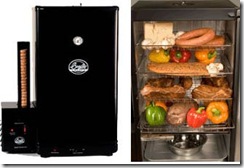
There is nothing like the satisfaction of hosting the perfect end of the season cookout. The perfect smoker will help you do that. If you have been comparing smokers, your search is over. Bradley Smoker has been making food smokers for the restaurant and hotel industry for over 12 years. Many of the finest hotels and restaurants around the world smoke their own foods using a Bradley Smoker, and no
w you can, too, and for only about $1.00 per hour. This is about the same as using wood chunks purchased in a store.
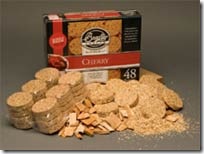
Bradley Smokers are known for their bisquettes, which are used in place of the wood chunks. The bisquettes are made with all natural products and the wood used is clean. It has not been used for other purpose before being made into a bisquette. This is not the case with all wood chips. Ask before you buy!
Below are a few commonly asked questions that may give you some ideas.
What is the difference between a cold or hot smoked product?Most smoked foods that are produced for resale are first cured and then cold smoked. Cold smoking is usually done below 100 degrees F. or below a temperature that burns or liquefies fat. Heat is added at the end of the smoking process for appearance and flavor. A hot smoked food needs very little curing and has the appearance, taste, and texture of fully cooked foods.
Why is cold smoke so important?
Creating smoke without heat is the best way to control the flavor of any food being smoked. In most food smokers heat is generated by burning wood. As the wood burns from ignition to complete ash the wood generates heat. At the point where wood is self-consuming (burns without any heat source) it produces a lot of heat. At this point there is very little smoke produced and the temperature within the smoker is out of control. A food smoker will produce a far superior tasting food if the temperature and smoke remain at a constant and controlled level.
What is a meat cure?
A meat cure is a combination of salt and sugar. It can be liquid or coarse granular and can include many other ingredients to enhance the flavor or preserve the meat. You can buy a meat cure from grocery stores, meat supply stores, or some butcher shops specializing in sausages and hams. You can also make your own; however make sure you have a proper
recipe and you know the correct proportions for the type of product you are smoking.
Can you cold smoke food without curing it first?
Yes you can. Try taking any meat product fresh out of cold storage and smoking at the coolest temperature possible. Do not let your smoker go above 100 degrees F. Season or marinade to taste. Only smoke for 1 to 2 hours and then cook as you would normally. Keep the damper at the top of your Bradley Smoker wide open, this helps in keeping the temperature low. This can be a little tricky in the middle of summer when the air temperature is above 60 degrees. The new flavors you can create on your grill or oven are fantastic.
What kind of wood goes well with seafood?
Certain types of wood give a better flavor with different food groups. There is no hard and set rule to this, however try using HICKORY or MESQUITE with pork, beef or red game meat. All types of seafood are excellent with ALDER, MAPLE or our own SPECIAL BLEND. Fruit woods work very well with poultry and fresh water fish. Try using CHERRY with wild duck or chicken.
Please share your smoking and party tips with everyone!
Friday, February 15, 2008
Learn about Grilling Safely on a Deck
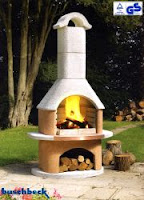
Fireplace grills are made for outdoor use, but what about on a deck. Better yet, what if the deck has a covered roof, but has open walls. These applications can be done as long as you have taken the correct precautions:
4.Proper insulation or separation (air space) should be employed between the chimney and the roof opening. Any licensed subcontractor who works on constructing the roof should be qualified to make this determination. The same considerations are made by carpenters building new homes (with indoor fireplaces) literally every day. The chimney does not get hot enough to be a problem unless the fireplace is overheated significantly with a fire that is much too big!
With this application you should also consider the following safety tips:
1. Always have a fire extinguisher on hand.
2. Never leave a burning product unattended, especially around children and pets, and make sure the fire is completely extinguished before leaving.
3. Check your local ordinances regarding outdoor wood burning.
4. When lighting or tending to the fire, make sure hair and clothing are away from the flame.
5. Burn only dry, seasoned wood (not treated wood) and make sure the smoke is not a nuisance to your neighbor
6.Keep all portable hearth products away from combustible material, e.g. outdoor furniture, pool towels, side of house, shrubs, etc.
7. Never use lighter fluid or gasoline to ignite your wood-burning product; use fire starters such as fibercones or lighting nuggets.
8. Be sure to make smores!