Showing posts with label Prunning. Show all posts

Thursday, February 26, 2009

February Pruning Tips

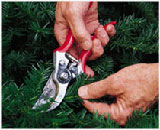
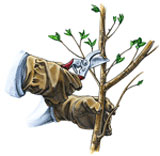
Most pruning of deciduous plants occurs in the dormant winter season. For best results, learn the growth habits of plants. For woody plants, remove dead, diseased, or damaged wood first. Then prune for shape, size, or fruit production. Remove suckers and water sprouts from flowering and fruiting trees. Prune plants that form flowers on wood grown the same season in late winter before buds swell. Prune most roses in late winter or early spring. Prune those that bloom once a year after blooming. In severe climates, cut back only wood that has died over winter. Prune only dead wood on climbers for the first two or three years. Prune old, shrub, and species roses lightly to shape them and remove dead wood. Shape hedges with the top slightly narrower than the base so light can reach lower leaves. Three basic tools suffice for most pruning jobs: shears, loppers, and a pruning saw. Keep them sharp for clean cuts; disinfect after pruning diseased material. Don't forget to stock up on gloves, one of the secondary, but very important, tools of pruning!! Yardiac.com has a great selection, for the most discriminating gardener.

Monday, October 27, 2008

Pruning Your Mountain Laurel

  One of our customer's had a question:  Can I prune my Mountain Laurel and if so when is the best time?  Also, can the Mountain Laurel handle topping (pruning which involves removing all branches and growths down to a few large branches)?

Mountain Laurel

  The answer is yes!  Mountain Laurel plants rarely need to be pruned, although pinching off the seed heads after blooming time is over seems to promote better flowering for the next season.  Should your Mountain Laurel plants get too tall for your landscape design plan, cut them back almost to ground level (topping).  These tough shrubs can take a severe pruning when necessary.  From stubs just a few inches above the ground new foliage will arise, and your plants will mature into large shrubs once again in about ten years' time.

  Over-grown shrubs, such as hollies, ligustrum, camellia and mountain laurel, can be cut back to bare branches 2 to 4 feet (or lower) from the ground.  The plant should recover in two to three years.  Recovery depends on the health of the plant and cultural practices such as fertilization, mulching, watering and insect/disease control. 

  The best time to prune your Mountain Laurel is in the Late Spring/Early Summer.  Pinch off clusters of spent blossoms.  Remove a few old branches at the ground to induce new growth from roots.

Wednesday, January 23, 2008

More on Pruning Crape Myrtles

The Crape Myrtle is a Sun worshipper. It performs like a pro in sunny, hot areas. When planting, be sure to give them a large area to spread. When given an ideal location, they will put on a spectacular show of color, an plumage, almost year round.

To help your Crape Myrtle gain a particular shape, start at the base. Remove all but three to five shoots. As the tree matures, remove lower, lateral branches one-third to halfway up the height of the tree. Remove branches that are crossing or rubbing against each other and shoots growing into the center of the canopy. Make your cuts to a side branch or close to the trunk. Head back wayward and unbranched limbs. As it grows taller, remove lower branches as needed. Remove any future growth from the ground to retain the desired tree shape. This basal sprouting may occur whether the tree is being pruned or not. Pull these out when succulent instead of pruning them.

You will notice some seed heads forming, in late Winter, or early Spring, and may have the urge to pluck them. This is not necessary. It will benefit, nor harm the tree to do so.

When you are faced with a much older tree that is in need of maintenance, you will basically do the same thing. Limb up, to remove obstruction of doors, or windows. If the Crape Myrtle is too close to a structure, consider removing one of the major trunks. Avoid cutting the top out, or 'topping', an aging tree.

To maintain the height of a Crape Myrtle, prune it moderately, by moving all twiggy growth back to lower growing side branches. This will unify the tree.

Corrective pruning is useful to promote a healthy tree. If you see a problem area, or dead branch, remove it immediately. All other times, simply prune by removing lateral branches, small twigs, or obstructing branches.

Tuesday, January 22, 2008

Crape Myrtle Pruning

Crape Myrtles bloom all summer long (around 120 days), which makes them perfect for landscaping. They are best suited for zones 6-11, and perform in a stellar way in hot, sunny climates. In the fall, Crape Myrtles boast bold color, and rustic peeling bark. Additionally, their natural form, is aesthetically pleasing. Who could ask for more?!

The question is how to care for the Crape Myrtle, to promote these very desirable features.

Light pruning is all that is necessary. Research indicates that flowering occurs with new growth. As for the timing, pruning in late Winter, or early Spring will give you the best results. This will stimulate regrowth, and in turn, blooming. If you will give the flowers a light pruning, once the they begin to fade, in Summer, you will have another explosion of blooms.

You will notice that some gardeners squarely cut the off the top, believing it encourages flowering the following Season. The only reason that your Crape Myrtle may require heavy pruning is if you require it to conform to a particular size or shape. Heavy pruning will not harm the Crape Myrtle, in any case.

If you are in the market for a Crape Myrtle, consider your landscaping, before you make an investment. There are many cultivars available. Choose one that suits your landscaping needs best. For example, you may choose a dwarf, a semi-dwarf, or a color variation. This will give you the benefit of light maintenance, and will allow the Crape Myrtle to showcase itself.

Share your Crape Myrtle stories, with the Yardiac.com Open Blog readers!

Tuesday, October 16, 2007

Pruning A Large Tree Limb

The best time to remove a limb from a tree is winter, except in the cases of maples, birches, and other trees that produce copious sap. For such trees summer is a better time (in subtropical climates the end of the dry season is preferred). If you can easily reach the limb with a ladder, there is no reason not to tackle the job yourself. However, if you’re thinking about climbing up into the branches to remove a limb, don’t. This is a dangerous task best left to professionals who have the proper training and equipment.
You can ensure your own safety by following a few precautions. Be certain your ladder rests on a firm base; if the ground is soft, set the ladder on some planks. Lash taller ladders to the tree and have someone hold the base of the ladder while you work. But keep other spectators away. And note where the limb will fall, making sure its drop won’t injure people or plants. If its fall might damage a valued shrub, say, tie a rope around it, pass the rope over another limb higher in the tree, and lower the cut limb slowly to the ground.
There are many reasons why you may need to remove a sizable limb from one of your trees. The limb may be damaged, diseased, or dead. It may be rubbing against another branch. Or it may just displease you; the tree would look better, you decide, without that particular branch. Any limb with a diameter greater than one inch should be sawed. For limbs up to two inches in diameter or even slightly larger, and for limbs growing close to another, a narrow, curved pruning saw is the ideal tool and is easy to use, as it cuts by a pulling rather than a pushing action. For cutting larger limbs, a straight pruning saw with teeth on both sides of the blade can be used. But handier for most amateurs (because it can be used for jobs other than pruning) is a bow saw, which has a detachable blade mounted on a C-shaped frame. In any case, do not use a chain saw, which is far too perilous for someone balancing on a ladder.
Now, another way to trim your trees, is with a pruning system. You eliminate the use of ladders, which makes it a lot safer. Fred Marvin pruners are used by professionals, everywhere, but they are also available to homeowners. They are lightweight, and easy to use. They are made of high-grade steel to permit several resharpenings, for a lasting and durable pruner. You can use use longer poles, to reach higher limbs. You can use special pruner heads, for trickier pruning.

Thursday, January 18, 2007

Prune Like a Pro!

Pruning is a vital part of plant and tree care. This task can be confusing, so we have developed the following guide to help you prune properly.Three basic tools suffice for most pruning jobs: shears, loppers, and a pruning saw. Keep them sharp for clean cuts, and disinfect after pruning diseased material. 1. Rose Pruning Prune in winter or early spring when plants are still dormant. Prune plants to maintain symmetrical bushes and to encourage strong new growth. Cut back all previous years growth as much as one-third its length. Remove branches that cross through center and remove plants understock. Also prune weak and dead stems as needed. This will also encourage strong new growth. 2. Crepe Myrtle Pruning The best time to prune crepe myrtles is in February. Prune out twiggy stems and any dead wood. Thin out crossing or crowding branches in the plants center. If tree form, prune lower branches. Prune top to maintain symmetry. Each year after flowering, cut 12 to 18 inches off the tips of branches that have bloomed. 3. Holly Pruning Prune in winter or early spring mostly to shape plants. Cut back wayward branches and prune out weak unproductive dead stems as needed. 4. Butterfly Bush Pruning Butterfly bushes bloom in summer on new spring growth. They can be pruned in late winter or early spring. By pruning old blooms you will encourage new flowers. Also prune out old dead and unproductive branches. 5. Hydrangea Pruning Hydrangeas fall into two groups. Some you prune in early spring and others after the flowers fade. Early Spring Pruning Hydrangeas bloom on new growth. These plants are Climbing Hydrangea, Annabelle, Grandiflora, and PeeGees. After-Bloom PruningHydrangeas bloom on last years stems. These include Bigleaf Hydrangeas, Oakleaf Hydrangeas, Lacecaps, SummerBeauty, and Nikko Blue. Pruning should be done when the flower has faded. Cut back the flowering stems to the strongest pair of new shoots. As plants mature, begin to thin out the oldest woody stems. Remove crowded crossing, broken, or dead branches. 6. Clematis Pruning Clematis can be put in three categories: Spring-flowering, summer-flowering , and twice-flowering. Spring-bloomingClematis produce flowers on stems that grew during the previous year. Prune when flowers are done blooming. Cut back the flowers that are now dead. Prune out any old dead stems as well. Summer-bloomingPlants bloom on new growth produced in the spring. Cut back stems before new growth begins. Late autumn or early spring is a good time to prune. Cut back about 12 inches of old growth. Each year the vine will grow larger and stronger. Twice-bloomingPlants first bloom in spring on stems produced the previous year. Late summer or fall will be the next bloom time. In late fall or very early spring, prune lightly to thin the stems. After the spring bloom, prune more heavily for more healthy stems to develop for the next bloom. After a second bloom, prune old flowers away. 7. Fruit Tree Pruning The most common fruit trees are apple, peach, pear and cherry. Apple TreesApple trees should be pruned in late winter or early spring before new growth starts. Always remove all suckers (summer is a great time). Also remove dead and other unproductive branches as needed. Peach TreesPeach trees are fast growing and need to be pruned in winter. Without pruning the peaches will grow farther away from the tree's center. This will put great strain on the branches, causing them to break. In winter, thin out upward-growing branches that cross in tree's center. Pear TreesPrune back in early spring. Always prune dead and unproductive branches as needed. Cherry TreesPrune in winter. Prune out branches that cross in center and dead unproductive branches as needed. 8. Azalea & Rhododendron Pruning They can be pruned in winter or early spring. However pruning at this time will prevent plants from producing many blooms. The best time to prune azaleas and rhododendrons is just after their blooming period in spring. If you prune at this time , no additional pruning will be necessary. 9. Juniper Pruning Junipers need very minimal pruning. They should be pruned to correct their shape, to accent their form, or to limit their size. This should be done during the juniper's growing stages in mid-summer. 10. Flowering Tree Pruning Flowering trees should be pruned after they have finished blooming. Prune as little as possible. Dead branches, branches that cross in the center, and branches that are unproductive should be pruned out. Again, don't forget the three basic tools for most pruning jobs: shears, loppers, and a pruning saw, and keep them sharp for clean cuts. Disinfect after pruning diseased material.

Tuesday, February 28, 2006

Prune Like a Pro

PruningPruning is a vital part of plant and tree care. This task can be confusing, so we have developed the following guide to help you prune properly. Three basic tools suffice for most pruning jobs: shears, loppers, and a pruning saw. Keep them sharp for clean cuts, and disinfect after pruning diseased material. We sharpen lots of knives around here, and the Accusharp is the best method we have found. 1. Rose Pruning Prune in winter or early spring when plants are still dormant. Prune plants to maintain symmetrical bushes and to encourage strong new growth. Cut back all previous years growth as much as one-third its length. Remove branches that cross through center and remove plants understock. Also prune weak and dead stems as needed. This will also encourage strong new growth. 2. Crepe Myrtle Pruning The best time to prune crepe myrtles is in February. Prune out twiggy stems and any dead wood. Thin out crossing or crowding branches in the plants center. If tree form, prune lower branches. Prune top to maintain symmetry. Each year after flowering, cut 12 to 18 inches off the tips of branches that have bloomed. 3. Holly Pruning Prune in winter or early spring mostly to shape plants. Cut back wayward branches and prune out weak unproductive dead stems as needed. 4. Butterfly Bush Pruning Butterfly Bush Pruning Butterfly bushes bloom in summer on new spring growth. They can be pruned in late winter or early spring. By pruning old blooms you will encourage new flowers. Also prune out old dead and unproductive branches. 5. Hydrangea Pruning Hydrangeas fall into two groups. Some you prune in early spring and others after the flowers fade. Early Spring PruningHydrangeas bloom on new growth. These plants are Climbing Hydrangea, Annabelle, Grandiflora, and PeeGees. After-Bloom PruningHydrangeas bloom on last years stems. These include Bigleaf Hydrangeas, Oakleaf Hydrangeas, Lacecaps, SummerBeauty, and Nikko Blue. Pruning should be done when the flower has faded. Cut back the flowering stems to the strongest pair of new shoots. As plants mature, begin to thin out the oldest woody stems. Remove crowded crossing, broken, or dead branches. 6. Pruning ClemantisClematis Pruning Clematis can be put in three categories: Spring-flowering, summer-flowering , and twice-flowering. Spring-bloomingClematis produce flowers on stems that grew during the previous year. Prune when flowers are done blooming. Cut back the flowers that are now dead. Prune out any old dead stems as well. Summer-bloomingPlants bloom on new growth produced in the spring. Cut back stems before new growth begins. Late autumn or early spring is a good time to prune. Cut back about 12 inches of old growth. Each year the vine will grow larger and stronger. Twice-bloomingPlants first bloom in spring on stems produced the previous year. Late summer or fall will be the next bloom time. In late fall or very early spring, prune lightly to thin the stems. After the spring bloom, prune more heavily for more healthy stems to develop for the next bloom. After a second bloom, prune old flowers away. 7. Fruit Tree Pruning The most common fruit trees are apple, peach, pear and cherry. Apple TreesApple trees should be pruned in late winter or early spring before new growth starts. Always remove all suckers (summer is a great time). Also remove dead and other unproductive branches as needed. Peach TreesPeach trees are fast growing and need to be pruned in winter. Without pruning the peaches will grow farther away from the tree's center. This will put great strain on the branches, causing them to break. In winter, thin out upward-growing branches that cross in tree's center. Pear TreesPrune back in early spring. Always prune dead and unproductive branches as needed. Cherry TreesPrune in winter. Prune out branches that cross in center and dead unproductive branches as needed. 8. Pruning Trees Azalea & Rhododendron Pruning They can be pruned in winter or early spring. However pruning at this time will prevent plants from producing many blooms. The best time to prune azaleas and rhododendrons is just after their blooming period in spring. If you prune at this time , no additional pruning will be necessary. 9. Juniper Pruning Junipers need very minimal pruning. They should be pruned to correct their shape, to accent their form, or to limit their size. This should be done during the juniper's growing stages in mid-summer. 10. Flowering Tree Pruning Flowering trees should be pruned after they have finished blooming. Prune as little as possible. Dead branches, branches that cross in the center, and branches that are unproductive should be pruned out. Again, don't forget the three basic tools for most pruning jobs: shears, loppers, and a pruning saw, and keep them sharp for clean cuts. Disinfect after pruning diseased material.