Showing posts with label Irrigation and Watering. Show all posts

Thursday, November 19, 2009

How to Select & Install a Rain Barrel

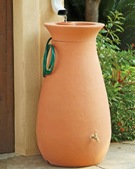
How many times have you watched a river of rainwater run down the driveway, and into the storm sewer, or even worse into your basement? The time has come for us to find solutions for rising water costs, stressed water systems, and dwindling resources. The answer is a Rain Barrell - Our Motto - Rain Water-Catch It-Use It! Prior to purchasing make sure your rain barrel is made of quality, food-grade material that is meant to hold water. Other types of water containers cannot be counted on to withstand the water pressure. Now when installing make sure it is set up on leveled surface (or blocks), so as to provide a safe spot for draining underneath, and a sturdy base to prevent tipping over. Always keep your rain barrels covered to prevent children or pets from falling in, and to keep mosquitoes and larvae from reproducing. Cover the downspout and drainage spots with netting or wire mesh to prevent mosquitoes and debris from getting in your water. Arrange your freeze proof rain barrel so that the overflow valve is facing away from your home's foundation.

Sunday, October 11, 2009

Heated Hose - Why Do You Need One?

Freezing temperatures are right around the corner and now is the time to prepare. For years we have recommend removing and storing your outdoor hose – check out our new “heated hose”. Heated hoses solve the problem of delivering water outdoors in temperatures below freezing. Yardiac’s thermostatically controlled hose has a 92" 120-volt electrical cord set attached, which activates a heating element built into the hose. Plug in hose when needed and unplug when finished. Thermostatically controlled heating element turns on if the ambient temperature is below 95°F and shuts off at 105°F. The heating element heats whenever the hose is plugged in. Frozen water in the hose thaws within 5 to 10 minutes (depending on the temperature) when plugged back in. • Ideal for watering animals once per day. • Excellent choice for promoting seed germination • Radiant Heating makes it idea melting ice and snow.

Monday, October 05, 2009

Water Retention For Coconut Fiber Planters

Keeping Hanging Planters Moist Many Yardiac’s tell us how much they love their coco-fiber hanging planters but hate how much water is wasted through the material. The coconut inability to hold excess water does prevent root rot and healthy flowers, however you will waste water. In order to prevent this problem we have been lining our hanging baskets with a thin plastic liner with holes punched through (a kitchen waste liner will do). This allows more water to be retained by the plants roots while still providing adequate draining. Recentely we discovered a better product called Soil Moist Mats. The easy to apply product is designed to reduce plant waterings by 50%. Soil Moist Mats absorb similar to a sponge and hold it in the plant container. Non-toxic crystals are woven into the degradable cloth material. As the soil begins to dry, the mat slowly releases stored water to the soil and the plant's roots over an extended period of time. They reduce plant waterings with less worry and save time and labor. The mats last for several seasons in the soil and are environmentally friendly. The easy to apply mat is ideal for containers, hanging baskets and potted plants for both indoor and outdoor applications.

Saturday, August 15, 2009

Stacked Stone Hose Reels

Stacked Stone Hose Reels Stacked Stone is one of the most popular materials used by lansdscape designers today. In order to keep up with this trend many many companies are developing a outdoor accents to match. One of the more popular is our cast stone hose reels. You can maintain a tidy yard with an elegantly designed hose reel made from the latest, maintenance-free materials. The commercial-grade steel reel makes it easy to wind up and stow away your garden hose. The heavy duty solid brass connector and thick steel axle are beautifully disguised in a decorative cast stone housing that compliments any outdoor decor.

Saturday, March 14, 2009

Knowing When To Water House Plants

Do you have trouble keeping your plants watered properly? If you answered no than either you are lying or should not be wasting your time reading this article because you have plants to monitor. Recently I discovered a new tool that really does help. It's called The Water Stick and it will automatically let you know the status of your plant by using a simple LED color sequence. 

It protects against under watering as well as over watering. The WaterStik is a break through in soil moisture measuring technology that makes it possible to accurately monitor the water content in any indoor potted plant's soil. I have been testing one for about three months and have over watered three plants, under watered three plants and properly watered three more (or so I thought). The WaterStick worked as advertised in all areas and even help correct my watering patterns.

Here is how it works: Simply place the WaterStik into the your plants soil. The top will Automatically blink when plant needs water or has recived too much water. The color of light indicates the plant's status . It Uses full spectrum LED technology and depth gauge technology allows to different plant types and watering habits.

Tuesday, July 29, 2008

What Are the Benefits of Rain Barrels?

There are many reasons to use rain barrels.  If you look closely, you will see that more and more homes are using rain barrels.  However, it is far from a new idea.  Catchinga rain water is a very old tradition, for many civilizations. 

Here are a few things to think about when considering a rain barrel:

As water storage needs change, the number of barrels in a system can follow suit.  Most all rain barrels can be linked together.

Rainwater is free of the additives, such as chlorine and fluoride, that can regularly be found in tap water.  This makes for much healthier plants, especially fruits and vegetables.  Additionally, rainwater is slightly acidic which is a plus for many plants.

Rain barrels can divert a limited amount of storm water from roofs, reducing strains on urban creeks and storm systems.  Rain barrels can also help prevent erosion around your own home.

If you are currently using rain barrels, please share your usage tips with your fellow Yardiacs! 

Monday, January 21, 2008

Greenhouse Watering

Watering can be tricky, whether in the greenhouse, in the home, or just outdoors. Sometimes, I find myself shaking my head, at my brown, and withering plant, and trying to decide if I have watered too much, not enough, or if there is some other unforeseen problem. Here are a few pointers, that should help you to be more knowledgeable about watering effectively.

Symptoms of over watering include bluish-green mold growth appearing on the soil's surface, sluggish growth, wilting, and yellowing leaves. Concerning yellow leaves, if you see that several leaves in one spot turn yellow and fall off, this is a sign of over watering. However, it can also be caused by air pollution from a heater or cold drafts. If you notice an increase in seedling or plant diseases or if seedlings germinate poorly, this can also be a result of over watering. Roots need air to grow, as well as water. If you crowd the soil with water, you leave no room for air. The roots begin to die. If you have an increased number of slugs to your plants, you are likely over watering.

Now, let us discuss the variables of watering. The more sun plants receive the more water they will need. More venting equals more watering. Plants have varying water requirements, depending on their environment of origin. The age of the plant will also affect the amount of water needed to survive. Seedlings, for example, must never dry out. Just don't over do it. You don't want your seedlings swimming, or smothering in mud. Sandy or well drained soils will require more frequent watering than clay, or potting, soils.

If you are new to gardening, and unsure of when to water, you are going to like this tip. Remove one inch of soil, from the top, and grab a handful. Form a three inch ball in your fist. Try to toss the ball, from one hand to the other. If the ball is powdery dry and won't form a ball, then water your plants. If the ball falls apart easily when tossed, water your plants. If the ball falls apart, but only after a few hard tosses, ten don't water. Check again, tomorrow. If the ball holds it's shape, don't water today. Come back in a few days.

After you are more a more seasoned gardener, you will be able to look at your plants and know if they need watering or not without a second thought. For now, maybe some of these tips will help you along. Be sure to post your gardening tips here, for others!

Thursday, December 06, 2007

Water Saving Techniques

Recycle Water
Reuse the water you use for cooking food such as corn and pasta. Do not use salter water, though as salt will damage the plants. let the water cool before pouring it on the plants.
Reuse your pet's drinking water.
You can use the water that you bathe in and the water that you wash dishes with to water the plants. The soap will not harm the plants.
Water from a dehumidifier can also be used to water plants.
Set out containers to catch any rainwater. Also, divert water coming down the rain spout towards a tree or shrubs.
Practice Effective Watering Habits
Do not water with an oscillating sprinkler. They waste water and often only water the foliage and do not allow the water to penetrate to the roots.
Do not spray plants with your thumb over the end of the hose for the same reason listed above.
Water SLOWLY and deeply. It is best to water plants by placing a hose at the base of the plant and running the water at a slow trickle. It is better to water plants less often, with more water, than to water daily with just a shallow watering. Some hoses have a smaller diameter, which allows for healthier watering techniques.
Soaker hoses are great and use substantially less water than any other watering practice. However, most people do not let them run long enough; they should run for at least six hours.
It is best to water early in the morning. The plants will use the water to survive the heat of the day and less water will be wasted through evaporation.
Another great water conservation tool is a portable drip-irrigation system, such as the TreeGator. There is virtually zero water loss! It is very simple, and easy, to use. Just place the bag on the tree, or shrub, fill with water, and forget it.

Monday, November 19, 2007

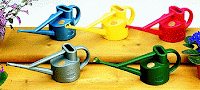
Haws Watering Cans

The Haws Professional watering can is the most sought after watering can, ever. It all began in the 1880's with a civil servant, John Haws. Unsatisfied with the French style watering can that dominted the industry, he set out to design the perfect watering can. -One that is perfectly balanced, and easy to carry. His patented style has remained virtually unchanged, since 1885.
The design that sets any Haws can apart from the vast sea of watering cans is the handle. John Haws designed a lid, or 'breast' for the watering can, and a neck to carry the separate spout and back handles. The body, base, handle, and spout support are all very distinctive features, as well.
After a metal Haws watering can is formed, and hand welded, it is set outdoors, to collect rust. The pits of the rusting process allow the galvanization to adhere to the can. All metal Haws watering cans endure this process. After they collect just the right amount of rust, they are bathed in molten zinc, which galvanizes them. It is certainly the most effective means of weatherproofing them. After that, they are off to be painted, polished, and sealed with the Haws insignia.
Since it's origination, changes are limited to material, finish, and size. There are small variances regarding the rose, as well. There is one for everyone. They are the 'Must Have' for any serious gardener.

Wednesday, January 24, 2007

Drought Defense:Three Smart Moves to Quench Your Garden's Thirst

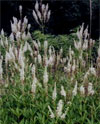
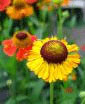
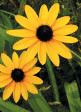
Plus, beautiful, drought-tolerant, plants to grow, in your garden. No one, not even a Yardiac, can control rainfall and prevent a drought, but you can make a few smart moves, right now, to ensure that your garden will sail through dry spells looking healthy and vibrant. As an added bonus, you'll lighten your gardening chores at the same time. Yardiac Tip #1: Mulch your gardenTop the garden soil around your plants with a thick blanket of mulch. Mulch helps the soil hold moisture, and it also keeps weeds down. Shredded bark is a good choice for mulch in flower gardens; spoiled hay and compost work well in vegetable gardens. You can also use grass clippings as long as they haven't been chemically treated. Yardiac Tip #2: Water with soaker hoses or drip systemsSoaker hoses are made from recycled tires; turn them on and let them "sweat"! Just wind a soaker hose around the plants in your garden. When you turn the water on it will flow through the microscopic holes in the hose and slowly saturate the soil. For a double dose of drought protection, combine moves #1 and #2: install your soaker hose, then cover it with mulch to prevent moisture from evaporating. Today's drip irrigation systems are much more flexible and improved over the unwieldy, clog-prone models of the past. Drip systems are well suited for use in flower and vegetable beds; you can even use them to keep your containers watered while you're on vacation, or saturate newly planted saplings. Just add an automatic timer, and suddenly your watering chores are over. Yardiac Tip #3: Choose Prairie PlantsTrue to their roots, prairie plants (both domestic and wild forms) are proving to be tough, reliable garden performers that require little care to keep them in top form. What's more, these resilient American natives feel right at home wherever they're planted, whether that's a suburban garden in the Midwest or a brownstone in New York City. Plants such as black-eyed Susan and purple coneflower evolved where droughts are commonplace, so they're much more tolerant of dry spells than shrinking violets with ancestral roots in a rainy climates. Here's a brief overview of some fabulous prairie plants for your garden: Culver's root, Veronicastrum virginicum, is a four-foot-tall beauty with candelabra-like bloom spikes that don't require staking. Culver's root is available in white- and pink-flowering varieties. Hardy from Zones 3-9. Red milkweed, Asclepias incarnata, grows three to five feet tall and produces large, flat seed heads that bloom in pale pink to cherry rose. Butterflies adore them in late summer. Common butterfly weed, Asclepias tuberosa, is another native that butterflies enjoy. Both plants are tolerant of seaside conditions and are hardy from Zones 3-9. Yarrow has fuzzy leaves and bold, flat flower heads. The spectacular, reliable 'Coronation Gold' variety looks as good in a manicured garden as it does in a rustic, wild setting. Hardy from Zones 2-9. Purple coneflower, Echinacea purpurea, is a popular low-maintenance perennial that thrives even in light shade, and grows up to 40 inches tall. A white form, Echinacea purpurea 'Alba', is just as appealing to bees and butterflies as its purple cousin, but it's shorter and less likely to reseed itself each year. Both are hardy from Zones 3-9. Helen's flower, Helenium autumnale, picks up the slack when other garden flowers are fading. Blooming in shades of yellow, orange, maroon and copper, Helenium is a tough-as-nails native that grows about three feet tall and is an attractive companion plant for asters and chrysanthemums. Hardy from Zones 3-9. Prairie false indigo, Baptisia lactea, is a rugged, spring-blooming perennial that develops upright black stems with white, pea-like flowers. A blue form, Baptisia australis, is also available. Both are extremely pest- and disease-resistant and grow two to four feet tall. Hardy from Zones 3-9. Helianthus is the bright yellow sunflower you've seen growing wild along the roadsides in the Midwest. A top-performing hybrid is the double-flowered Helianthus multiflorus 'Flore-pleno'. This five-foot-tall giant is in nearly constant bloom July through September and makes excellent, long-lasting cut flowers. Hardy from Zones 4-10. Bee balm or monarda, Monarda didyma is a domestic garden staple that blooms in reds, pinks and purples. The blooms for both wild and domestic varieties are rounded and fringy, resembling fireworks opening and cascading back to earth. Bees, butterflies and hummingbirds love to visit these flowers. Hardy from Zones 3-9. Joe-pye weed, Eupatorium maculatum, grows five feet tall. The striking plant bears large flat reddish-purple flowers from July to September and is much relished by bees and butterflies. Hardy from Zones 2-8. Black-eyed Susan, Rudbeckia hirta, is likely the most popular native flower of all. This never-say-die perennial tolerates all sorts of neglect and keeps on blooming. Black-eyed Susans, including variety 'Goldsturm,' make long-lasting cut flowers, too. Hardy from Zones 3-8